News
2 October 2026
Busitema Researcher Presents Cross-Region Study on Crop Disease AI at EUVIP 2026
Artificial intelligence can learn to recognise crop diseases with impressive accuracy, but a model that works well on familiar images may become less reliable when it encounters crops grown in another part of the world.
That problem was at the centre of research presented by Rosemary Nalwanga, a PhD candidate at Busitema University, at the 14th European Conference on Visual Information Processing, EUVIP 2026, held in Luxembourg from 28 September to 1 October.
Nalwanga presented the paper “Multi-Crop Leaf Disease Recognition: A Unified Benchmark and Cross-Region Study” as part of the conference programme on Vision for Earth and Space. The official EUVIP programme placed the work within an oral session devoted to applications of computer vision to challenges involving the Earth and space.
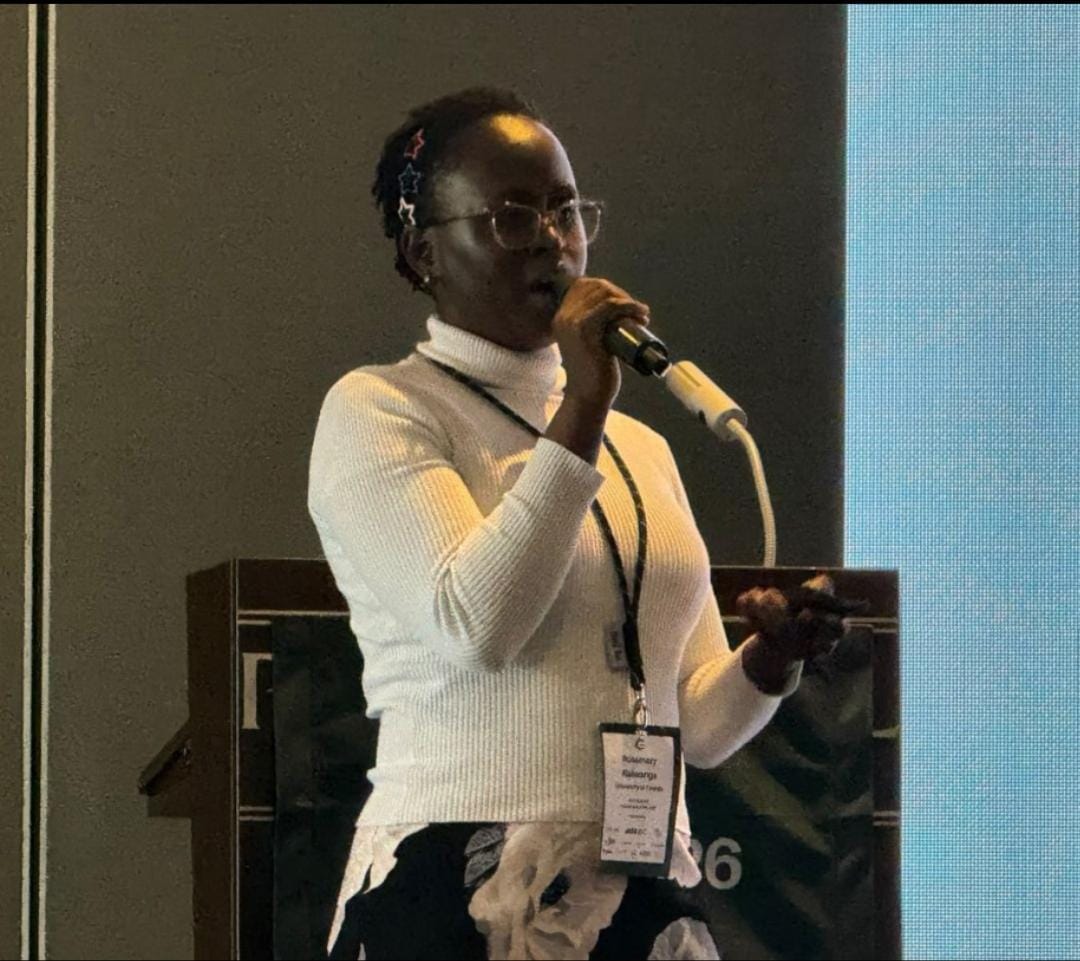
The study brings together crop leaf images from the United States, Asia and Africa to examine how well disease recognition models continue to perform when they are tested outside the geographical settings represented in their training data.
Training the models with more geographically diverse data improved their performance across regions, but a substantial gap remained. The result raises an important question for agricultural AI. A system may perform extremely well on data drawn from familiar conditions, but can that performance be maintained when the crop variety, climate, growing environment and other conditions change?
Nalwanga had raised the same concern ahead of the conference, noting publicly that models which perform exceptionally well within the environments represented in their training data can deteriorate when exposed to data from another region. She described the EUVIP paper as part of a wider effort to develop low-cost computer vision for multi-crop disease detection and recognition in resource-constrained farms.
The paper was co-authored by Rosemary Nalwanga, Sebastian Bunda, Luuk Spreeuwers, Godliver Owomugisha and Estefanía Talavera. The work is also listed among 2026 publications associated with the University of Twente's Data Management and Biometrics research community. Dr. Estefanía Talavera
Nalwanga’s presentation placed the study within a wider international conversation on visual information processing, bringing together researchers and practitioners working on how artificial intelligence can interpret and analyse images and other visual data.
The Luxembourg Convention Bureau, in its post-conference coverage, reported that EUVIP 2026 brought together participants from academia and industry across fields including deep learning, medical imaging, biometrics and forensics, Earth observation, autonomous systems, image restoration and visual AI. The four-day programme combined keynote talks, tutorials, oral and poster sessions, demonstrations, panel discussions and industry activities.
Within that wider discussion, Rosemary Nalwanga’s study, “Multi-Crop Leaf Disease Recognition: A Unified Benchmark and Cross-Region Study,” focused on a practical weakness in agricultural AI. Crop disease recognition models learn from collections of labelled leaf images, but strong results on familiar data do not always hold when those same models are tested on images from different regions and under different conditions.
Differences in crop varieties, growing environments and agricultural conditions can alter what a model encounters.
This concern had already emerged from earlier research by Nalwanga and her collaborators. In 2025, Nalwanga, Luuk Spreeuwers, Estefanía Talavera and Dr Godliver Owomugisha published “Multi-Crop Disease Detection in Computer Vision for Resource-Constrained Farms—A Review” in IEEE Access. The paper examined advances and remaining challenges in applying computer vision and machine learning to crop disease detection, with particular attention to multi-crop and resource-constrained farming environments.Among the problems identified were limited dataset diversity, poor model generalisation and insufficient testing under real-world conditions.
The authors paid particular attention to geographical variation. Their review noted that a model trained using data from one region may fail to perform equally well elsewhere because conditions such as climate, soils, crop varieties and farming practices vary from place to place. They argued for the inclusion of geographically diverse datasets when training crop disease recognition systems.
The EUVIP study takes that problem from review into experimental testing by bringing together leaf images representing Africa, Asia and the United States to examine what happens when disease recognition models move beyond the geographical conditions they already know. The findings show that training with more diverse data improves performance across regions, but the remaining gap indicates that broader data alone has not yet solved the challenge of building models that generalise reliably from one region to another.
The 2025 review observed that many crop disease recognition approaches remain focused on individual crops, even though intercropping is common among smallholder farmers in many developing regions. It also identified practical barriers including limited internet connectivity, the computing demands of some models and the difficulty of translating systems developed under controlled conditions into tools that can operate reliably in the field.
The authors called for more diverse datasets, lightweight models, offline-capable applications and stronger validation in actual farming environments.
The study builds on a broader line of research involving Busitema University’s AI and Interdisciplinary Research Group, BUAIIR, and the Data Management and Biometrics group at the University of Twente. Nalwanga is pursuing her PhD through this collaboration, while co-author Dr Godliver Owomugisha, Director of the BUAIIR Laboratory and a Senior Lecturer at Busitema University, has research interests in computer vision and machine learning for plant disease diagnosis.
The cross-region study now adds experimental evidence to that work. By showing that broader training data can improve performance without fully closing the gap between regions, it shifts attention from how well a model performs on a familiar dataset to how reliably it can work when conditions change.
That distinction becomes important when such systems move from research environments into farmers’ hands. An image-based diagnostic tool must be able to recognise disease in the crops and conditions it encounters in the field, even when those conditions differ from those represented in the data used to train it.
The work presented in Luxembourg brings the challenge into sharper focus. As crop disease recognition moves towards practical use, the real test will be whether models can maintain their performance across different regions, crop varieties and field conditions. The cross-region study shows that broader training data helps, but the remaining gap leaves researchers to build systems that farmers can rely on across conditions different from those used during training.
Assoc. Prof. Egonyu Turns Soroti’s Organic Waste into Feed and Fertiliser
27th September 2026
Soroti City generates about 165 tonnes of waste each day, and more than 70 per cent of it is organic, a volume of biodegradable material that Assoc. Prof. James Peter Egonyu’s work at Busitema University is seeking to put to use by raising Black Soldier Fly larvae for animal feed and turning the residue from the process into organic fertiliser.
Assoc. Prof. Egonyu brought that work to the 4th Busitema University Annual Science, Technology and Innovation Symposium, held in Soroti from 23 to 25 September 2026. His keynote, Turning Urban Organic Waste into Fertilizer and Animal Feed: Busitema University’s Black Soldier Fly Innovation, drew together several years of work by Busitema University on insect farming, waste recycling and the search for agricultural products that can be made from materials already available locally.
An Associate Professor of Agricultural Entomology at Arapai Campus, Egonyu has built part of his research around insects that can serve agriculture in more than one way. His interests include farming insects for food and feed, recycling waste into biofertiliser and crop pest management.
The Black Soldier Fly, Hermetia illucens, has become central to that work. Its larvae consume biodegradable material and grow rapidly on it. Once harvested, the larvae can provide a protein-rich ingredient for animal feed, while the residue from the feeding process, commonly called frass, can be used as fertiliser.
Busitema University has been testing how that process performs with the kinds of waste farmers and towns in Uganda actually have.
Under the project Commercialising Black Soldier Fly Farming for Livestock Feed and Organic Waste Recycling into Biofertilizer in Tororo and Soroti, rearing facilities were established at the Faculty of Agriculture and Animal Sciences in Arapai and the Faculty of Science and Education in Nagongera. By the time the project closed, 289 farmers from 54 districts had been trained, four farmers were reported to have adopted Black Soldier Fly farming, five students had taken part in research and two professional staff had received training.
Researchers wanted to know which locally available materials could support good larval production and what kind of fertiliser would remain afterwards. That led to trials using market food waste and brewers’ spent grain, together with studies of larval performance, the nutrient composition of the resulting frass and its use on vegetable crops.
The work also produced a draft paper titled Market Food Waste and Millet Spent Grain as Substrates for Producing Black Soldier Fly Larvae Meal and Biofertilizer. Busitema University’s project report records the manuscript as a draft intended for journal submission.
One product to come out of the project is BUINFERTZ, a Black Soldier Fly-based agricultural input developed by the University. Busitema’s account of the project lists the fertiliser among its major outputs alongside farmer training, student research and testing of local organic substrates.
In a peer-reviewed study published in the Journal of Insects as Food and Feed, Assoc. Prof. Egonyu joined researchers examining how Black Soldier Fly frass performed in maize production. The study compared the frass with mineral NPK fertiliser, compost made from brewers’ spent grain, a commercial organic fertiliser and untreated soil under greenhouse conditions.
Maize grown with Black Soldier Fly frass produced higher grain yields than maize grown with NPK, brewers’ spent grain compost and the commercial organic fertiliser at the rates tested. The researchers also found that combining frass with NPK produced the highest net income among the treatments they assessed.
Those findings help explain why Assoc. Prof. Egonyu’s work at Busitema has continued to follow both products coming out of the same process. The larvae have value as an ingredient for animal feed, but the material left behind can also return to crop production rather than becoming another waste product.
The Soroti work is now taking that idea into a larger urban setting. Through the Waste to Wealth project, known as WAWE and funded by the Climate and Clean Air Coalition of the United Nations Environment Programme, Busitema University and its partners are working with organic market waste in Soroti and exploring how it can be turned into animal feed and fertiliser while supporting businesses around collection and processing
According to Assoc. Prof. Egonyu’s symposium presentation, Busitema University has established a model small-scale commercial Black Soldier Fly facility capable of processing about four tonnes of organic waste each week.
Four tonnes a week is still only a fraction of the organic waste Soroti produces, but it moves the discussion away from what Black Soldier Fly farming might do in theory. The University now has farmers who have been trained, facilities where the insects are reared, products being developed, student research coming out of the work and a city where the raw material is produced every day.
That is where Assoc. Prof. Egonyu’s keynote found its strongest connection with Soroti. The city has an organic waste problem, while farmers need affordable sources of feed and fertiliser. His research is bringing those two realities into the same conversation, using an insect to move material from one side to the other.
Instead of ending its usefulness in a market bin or waste collection point, part of Soroti’s organic waste could return to agriculture as feed for livestock and nutrients for crops. Assoc. Prof. Egonyu’s work is now concerned with whether that cycle can be made reliable enough, affordable enough and large enough to become part of how the city handles the waste it produces.
Read the research
Performance of Black Soldier Fly Frass Fertiliser on Maize (Zea mays L.) Growth, Yield, Nutritional Quality, and Economic Returns, published in the Journal of Insects as Food and Feed, Volume 8, Issue 2, pages 185–196. Brill
AI Is Entering Government Faster Than Policies Can Keep Up
2 October 2026
Artificial intelligence is already making its way into government work, with public institutions using it to search for information, summarise documents, detect fraud, answer questions and support service delivery. World Bank Blogs
Uganda is among the countries highlighted in new World Bank research on the use of artificial intelligence in government. The study reports that the country has developed an AI-HR Assistant, a chatbot designed to respond to human-resource queries from within an electronic document management system. Elsewhere, governments are using AI to identify possible tax fraud, analyse medical images, support examination marking and help citizens navigate legal information.
As that adoption gathers pace, the policies and systems needed to guide the use of AI are not always developing at the same rate.
That gap is one of the main findings from a new World Bank study covering government use of artificial intelligence in 60 economies. The research gathered information directly from central digital agencies, ministries and officials responsible for government information systems.
AI use was already widespread among the governments surveyed, but much of it had not yet become part of formal institutional processes.
Forty-four per cent of internal government AI use involved individual public servants using the technology for tasks such as searching for information, summarising documents and obtaining basic assistance. The World Bank describes this as relatively informal use because the tools are being used by individuals rather than being built into established government workflows.
That distinction becomes important once AI begins handling government information or contributing to decisions. A public servant using an AI tool to shorten a report is one thing. Using the same technology to process administrative records, respond to citizens or support decisions affecting public services brings questions about privacy, accuracy, security and responsibility.
The survey shows that many governments are still working out those questions. Nearly two-thirds of the governments surveyed provide public servants with licences or official access to generative AI tools. Only 39 per cent had formal ministry-wide guidelines governing their use, while another 38 per cent said such guidelines were still being developed.
The World Bank refers to one consequence as "shadow AI", where employees use artificial intelligence without enough institutional guidance or oversight. This can leave uncertainty over what information may be entered into an AI system, when a human should review its output and who is responsible when AI contributes to a government decision.
The challenges are not the same everywhere because among low-income economies in the survey, 58 per cent identified the absence of AI policies, guidelines, frameworks or standards among their three biggest barriers to adoption. Data quality and availability were also repeatedly identified as obstacles across countries at different income levels.
Uganda's human-resource assistant is one example. Burkina Faso has developed an AI assistant to help people navigate legal information, while the Democratic Republic of Congo is using an AI system to support the correction of state examinations. The Philippines is applying predictive AI in tax administration and Thailand is using the technology in the detection of tuberculosis and lung cancer from chest X-rays.
These examples shift the discussion from whether governments will use AI to how they will use it well.
That is also where the findings become relevant to university research. Busitema University already has researchers working in artificial intelligence and related technologies. The Busitema University Artificial Intelligence and Interdisciplinary Research Group develops AI applications in areas including health, agriculture, climate, computer vision and robotics. Its work also includes the development of datasets and attention to ethical data practices.The University's Department of Computer Engineering and Informatics lists artificial intelligence, data science, cybersecurity, computer forensics and cyber-physical systems among its areas of expertise. It also offers a Master of Science in Artificial Intelligence and identifies collaboration with government and other organisations as part of its research work.
Researchers can examine how public institutions handle sensitive data when using AI, how outputs are checked before they influence decisions, how systems can be protected from security threats and whether public servants understand both the capabilities and limitations of the tools they are using.
An AI application may work during a small pilot but behave differently once it is connected to larger databases, used by hundreds of staff or placed inside a public service that people depend on every day. Researchers can test accuracy, reliability, bias and system performance under those conditions.
The human side is just as important because public servants need enough understanding of AI to know when its output is useful, when it requires checking and when human judgement should take priority. The World Bank argues that governments need stronger skills, better data systems and organisational structures that allow experimentation to become institutional learning.
These are questions that sit across several fields rather than inside computer science alone. Cybersecurity researchers can examine how government data is protected. Data scientists can study the quality and suitability of the information used to train or operate AI systems. Researchers in public administration can look at accountability and institutional processes, while legal and ethical research can examine what safeguards are needed when automated systems begin influencing public decisions.
Busitema's existing work in artificial intelligence gives the University a foundation from which some of these questions can be explored. Its AI research group brings together people from different academic backgrounds, while the Department of Computer Engineering and Informatics already works in areas closely connected to secure and responsible digital systems.
As AI becomes part of everyday government work, it is opening new opportunities to improve how institutions manage information, support staff and deliver public services. Research can help show how these systems perform in practice and how they can be integrated responsibly and effectively into public institutions.
Uganda's appearance in the World Bank study shows that this transition is already underway. The bigger task now is ensuring that the systems surrounding AI develop as quickly as the technology itself.
Read the original World Bank article, How are governments using AI? New evidence from around the world
Graduation marks the end of formal study, but not the end of learning. Much of what eventually makes someone effective at work is picked up after entering the workplace for instance; solving unfamiliar problems, working with colleagues, adapting to new technology, dealing with clients and learning how an organisation actually operates.
World Bank analysis published in September 2026 estimates that roughly half of the human capital people build over their working lives comes through experience on the job. Yet workplace learning receives far less attention in education and skills policy than schools, universities and formal training programmes.
The argument is backed by evidence showing that what happens inside a workplace can have measurable effects on performance.
Among garment workers in India, an on-the-job programme focusing on communication, time management, problem-solving, decision-making and teamwork increased productivity among participating workers by more than 13 per cent. In Togo, training that encouraged small-business owners to become more proactive and opportunity-focused increased profits by about 30 per cent, with effects still visible years later.The World Bank uses such findings to make a broader point that employment can also be part of the education process. That distinction matters in countries where many young people enter jobs that offer little room to build new skills. Around 70 per cent of workers in low- and middle-income countries are concentrated in small-scale agriculture, low-quality self-employment or very small firms. These jobs may provide income, but they do not always expose workers to new technologies, stronger management practices or experienced colleagues from whom they can learn.
Uganda is included among the countries whose labour-market programmes have been studied in this wider body of evidence. Research cited by the World Bank shows that programmes helping young people enter employment and gain practical experience can improve both skills and earnings.
Universities often assess the transition from study to work by looking at whether students secure internships and whether graduates find employment. The World Bank findings suggest that another part of that transition deserves attention. What graduates learn once they enter the workplace can continue shaping their skills long after they leave university.
Busitema University already places students and graduates in environments where that question can be studied more closely. Internship and work-placement programmes expose students to workplaces before graduation, while graduate tracer studies and employer surveys offer another way of seeing how university training holds up once graduates enter employment.
The University has also previously participated in the Work Readiness Program implemented with the Private Sector Foundation Uganda and Enabel, which placed graduates in workplaces across sectors including agro-processing, construction, tourism and ICT. The programme was designed to give graduates practical exposure to the workplace while helping them develop the skills and confidence needed to move more effectively into employment.
Evidence now emerging internationally suggests that the quality of those workplace experiences deserves as much attention as the placement itself.
A student who spends three months in an organisation may complete an internship requirement without necessarily gaining much. Another student in the same period may work under close supervision, handle real assignments, learn new systems and leave with skills that could not easily have been developed in a classroom.That presents a useful area of study at Busitema University. Researchers could examine how graduates' skills change during the first years of employment, which kinds of workplace supervision support stronger learning, and whether some placement environments expose students to more meaningful responsibilities than others. Graduate tracer studies, employer surveys and internship evaluations could also help identify which skills develop quickly after recruitment and which gaps remain over time.
This kind of research could involve education, business, engineering, computing and other disciplines where students move directly from academic training into professional practice. It could also give academic programmes stronger evidence on what should be developed before graduation and what is better strengthened through workplace experience.
The World Bank's argument ultimately challenges a familiar assumption about employability. A degree may open the door to work, but what happens after someone walks through that door can shape just as much of the worker they eventually become.
Read the full World Bank article behind the newsletter feature Why Governments Are Overlooking the Workplace as a Classroom.
Safe at the Source, Not Always Safe at Home: New Data Tracks Drinking Water Contamination
1 October 2026
Water collected from a borehole, protected spring or piped supply may be safe when it leaves the source but what happens on the journey to the household can change that.
New World Bank data shows that contamination can enter drinking water during collection, transport, storage and everyday handling, meaning that access to an improved water source does not always guarantee that the water eventually consumed is safe.
The analysis, published on 8 September 2026 as part of the Atlas of Global Development 2026, reports that 2.1 billion people worldwide still lack safely managed drinking water. More striking is the difference between water tested at the source and the same supply assessed where people actually use it. In 28 of 30 countries with comparable data, a larger share of people was exposed to contamination when water was tested at household level than at the original source.
Contamination can be introduced through something as ordinary as an uncovered storage container, an unwashed cup or a hand dipped into stored water. The problem therefore extends beyond the condition of a borehole, tap or spring. It includes what happens after the water has been collected.
That distinction matters because international standards for safely managed drinking water consider more than the type of source being used. Water should be accessible on the premises, available when needed and free from contamination. The World Bank analysis identifies water quality as one of the most difficult barriers to meeting that standard.
Uganda is dealing with the same problem while making progress in some areas of water-quality management.
The Fourth National Development Plan 2025/26–2029/30 reports that compliance with drinking-water quality standards for point water sources improved from 41 per cent in 2017/18 to 55 per cent in 2023/24. Compliance for piped water increased from 60 per cent to 71 per cent over the same period. The Plan, however, also reports that more than 80 per cent of urban water sources are contaminated, with untreated waste, indiscriminate disposal of plastics and other pollutants contributing to the problem.
Uganda's response increasingly depends on better monitoring as well as infrastructure. NDP IV includes stronger enforcement against water pollution, improvements in hydrological information systems and plans to construct and equip a National Water Quality Reference Laboratory. Academia is among the actors identified in the Plan's approach to sustainable water-resource management.
Research at Busitema University already shows how some of those questions can be approached.
In 2026, Joseph Pelerino Lolem, working in the Department of Water Resources Engineering, developed a hybrid model for predicting river-water quality in Uganda's Malaba River catchment. The study combined the Soil and Water Assessment Tool with an artificial neural network using hydrological, climate, land-use and pollution data. The artificial neural network achieved 84.47 per cent accuracy in classifying water quality, with sediment and turbidity emerging as important drivers.
Another study by Sonia Dorothy Baaya in 2024 took a different approach. She designed and constructed a cost-effective Internet of Things-based water-quality monitoring system at Busitema University. The system was developed to collect and transmit water-quality data in real time, allowing changes to be detected more quickly than approaches that depend only on periodic laboratory testing.
The latest global findings add another layer to work of this kind. Knowing whether a river, borehole or piped supply is contaminated remains important, but the evidence raises questions about what happens after water leaves those sources.
Where along the journey from collection to consumption does contamination enter? How much do storage containers, transport methods and household handling affect water quality? Which communities face the greatest exposure? Can low-cost monitoring technologies identify changes early enough to prevent people from consuming unsafe water?
These are questions that can bring together expertise already found across Busitema University, including water engineering, environmental science, public health and data science. They also create room to move research closer to households and communities, where the difference between water that is available and water that is actually safe becomes visible.
That direction fits within Busitema University's wider research agenda. The University identifies Health and Wellbeing and Agriculture and Environment among the themes around which it seeks to build high-impact research, alongside Digital Futures and Transformative Technologies. Its strategic plan also places emphasis on research that produces scientific and social impact within communities.
The figures shift attention from the water point to everything that happens afterwards. A borehole may test clean in the morning and still fail to deliver safe water to the person drinking from a household container later that day. Finding where that safety is lost, and how to prevent it, is now part of the water challenge.
Read the original World Bank article, Water quality: safe at the source isn't safe at the glass.
The Directorate of Information and Communication Technology Services (DICTS) at Busitema University has successfully implemented a modern, sustainable power backup system to ensure uninterrupted operation of the university’s server infrastructure.
This new power solution integrates solar energy, lithium battery storage, and grid (hydro) electricity into a seamless and intelligent system designed to guarantee reliability, efficiency, and resilience.
How the System Works
The setup consists of 38 solar panels that harness clean energy during the day. This solar power directly supports the server room operations while simultaneously charging a high-capacity lithium battery system.
At night, the system automatically switches to grid (hydro) power as the primary source of electricity. In the event of a grid power outage, the lithium battery—charged during the day—instantly takes over, ensuring continuous power supply to critical systems.
All transitions between power sources are managed by a smart inverter, which enables automatic, seamless switching without any interruption to services.
Key Benefits
- Uninterrupted Services: Ensures continuous availability of university digital systems and services.
- Energy Efficiency: Maximizes the use of solar energy, reducing dependence on grid power.
- Sustainability: Promotes green energy adoption and reduces the university’s carbon footprint.
- Reliability: Provides a robust backup mechanism in case of power outages.
- Automation: Eliminates manual intervention through intelligent power switching.
Supporting the University’s Digital Mission
This initiative reflects DICTS’ commitment to strengthening the university’s ICT infrastructure and supporting teaching, learning, research, and administrative functions through reliable technology services.
By adopting this hybrid power solution, Busitema University continues to demonstrate leadership in leveraging innovative and sustainable technologies to enhance institutional efficiency and service delivery.
In an effort to ensure a smooth transition into university life, first-year students at various campuses received a comprehensive orientation on University systems. The orientation, held on between 7th of September to 15 of September 2023, provided newcomers with valuable insights into the array of systems and resources available to them throughout their academic journey.
The orientation covered a wide range of essential topics, including:
- The Admission System
- Students Portal System
- Varous websites including the main University Site
- Introduction to eduroam internet
Among others
The orientation sessions were led by experienced faculty and staff members who were available to answer questions and provide guidance. Attendees were also given access to online resources and handouts for future reference.
Busitema Universoty, Directorate of ICT remains committed to supporting the success of its students and believes that a strong understanding of campus systems is crucial for a successful academic journey. This comprehensive orientation serves as a crucial first step in helping first-year students make the most of their university experience
To register for institutional mail, please fill in the following forms. Forms are to be filled according to respective faculties. Click here to access forms
 MISSION: “TO PROVIDE HIGH STANDARD ICT SOLUTIONS FOR TEACHING, LEARNING AND RESEARCH FOR A TRANSFORMATIVE SOCIETY”.